





The institutional relationship management with artificial intelligence is undergoing a profound and driven transformation. The techniques of the past have become outdated where the focus was exclusively on contact agendas, press releases or formal meetings. Today, organizations must navigate a hyper-connected, changing and information-saturated environment, where every move, every word and even every silence can directly influence their public image or strategic interests.
Now, the artificial intelligence in institutional relations is presented as an essential tool by applying advanced algorithms, natural language processing and massive data analysis, it is possible to anticipate critical situations, detect political or social opportunities, and build stronger and more effective institutional links.
Thanks to AI, it not only streamlines processes that used to require days of human labor, but also provides continuous strategic insight. It allows you to understand how the public conversation is evolving, which narratives are gaining space in the media, and how to position yourself in a way that is consistent with corporate values and objectives.
Corporate reputation under the Artificial Intelligence magnifying glass

Today more than ever, an organization's reputation can change in a matter of minutes. A leak on networks, a mention in an influential media outlet or a public misinterpretation can escalate quickly if not handled swiftly. This is why AI applied to reputational analysis is gaining ground in companies, public institutions and third sector organizations.
Using active listening techniques, semantic analysis and automatic source classification, today's systems are able to accurately evaluate the impact, tone and evolution of public perception about a brand or figure. And they do it not once a month, but every hour, every minute.
What is most interesting is how these tools allow you to customize the approach. For example, Enigmia trains models with the same criteria that the human team would use, ensuring that the analyses are not only automatic, but aligned with the organization's strategy. This avoids algorithmic biases and ensures that AI acts as an extension of corporate thinking.
This not only detects reputational risks at an early stage, but also identifies opportunities to reinforce positive media presence, consolidate brand values or respond with agility to changing environments.
You may be interested in ▶ Monitor your reputation in real time with AI
Real-time legislative analysis
The regulatory environment changes at a speed that often exceeds the organizations' capacity to react. From proposed legislation to administrative reforms or sectoral regulatory frameworks, the challenge is not only to understand what is changing, but also to anticipate and act before change occurs.
Thanks to AI, it is now possible to make a automated parliamentary monitoringIt is able to detect relevant keywords, relate them to specific interests and issue alerts in real time. This technology processes official bulletins, debates legislativeThe company has also been able to identify and analyze the information of interest, bills and other public or private documents, cross-checking information to reveal patterns of interest.
For example, a company in the energy sector can configure its system to receive alerts for any mention of "energy transition", "green hydrogen" or "green hydrogen".CO₂ taxes"in Congress or the Senate. The difference between acting with this information or without it is substantial because, normally, time is gained to align speeches, prepare positions, strengthen strategic alliances or initiate well-founded institutional influence campaigns.
Enigmia goes a step further by not only identifying legislative changes, but contextualizing them with predictive analytics, cross-referencing them with reputational, industry or social behavior data. A 360º vision that enables informed and timely strategic decisions.
Institutional relations based on data (not intuition)
Traditionally, many decisions in institutional communications have been made based on experience, political savvy or intuition. And while these skills are still valuable, in today's volatile environment, they are not, data should complement and reinforce each step taken.
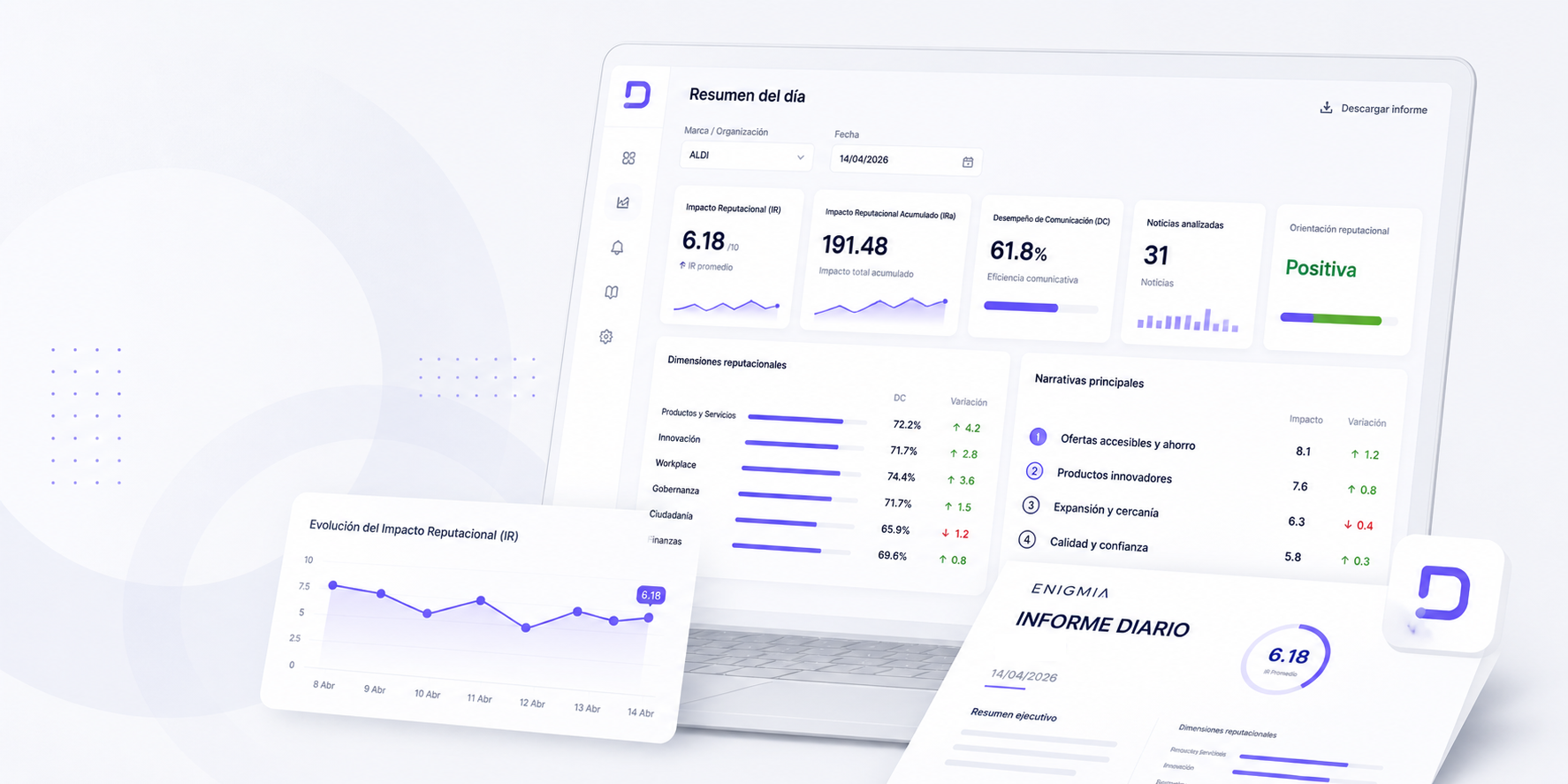
Artificial intelligence offers interactive dashboards that make it possible to visualize, in real time, how institutional discourses are evolving, which topics are gaining relevance in public opinion and which actors are having the greatest influence on each conversation.
Thanks to these types of panels, decisions can be taken based on concrete evidencenot only in perceptions. Thus, a lobbying strategy, an institutional campaign or a public intervention can be adapted on the fly if the data show that the impact is not as expected.
In addition, this approach strengthens institutional relations departments internally. Visual and quantifiable information makes it possible to justify decisions to the executive committee, request resources based on tangible results or demonstrate the return on investment (ROI) in positioning campaigns.
How Artificial Intelligence transforms every institutional interaction
Sometimes, when talking about artificial intelligence applied to institutional relations, there is a risk of falling into the abstract. But the truth is that this technology is already present in everyday actions, with measurable results.
A clear example is the analysis of conversations in contact centers. There, the AI not only transcribes calls but also interprets emotions, assesses the tone of speech and detects signs of potential conflict. This allows institutional decision-makers to anticipate citizen trends, collective complaints or changes in public perception.
Another key case is that of the identification and evaluation of spokespersons or brand ambassadors. Thanks to the processing of public data and social networks, systems can determine which people really influence a niche or community, analyze their values, their communication history and their level of consistency with the organization's image. This functionality is especially useful for selecting opinion leaders in institutional or regulatory contexts.
Also noteworthy are the capabilities for the massive analysis of human behavior through geolocation and sociodemographic data. Properly implemented, these techniques offer an accurate x-ray of an organization's operating environment, identifying areas of opportunity, hotspots of tension or emerging audiences that can become strategic allies.
And no less important is the possibility of evaluating, in real time, the effectiveness of institutional campaigns, lobbying or public positioning. Through AI, it is possible to measure not only the reach, but also the emotional reaction of audiences, virality of messages and consistency with the desired narrative..
All of this makes artificial intelligence a cross-cutting resource that feeds business decisions, strategic planning and public policy design.
Economic models that turn data into decisions
One of the most innovative areas of artificial intelligence applied to institutional relations is its capacity to translate intangibles into concrete economic dataHow do you measure the impact of a solid reputation? How much is it worth to prevent a crisis before it erupts? What is the real return on a well-executed institutional campaign?
This is where the intelligent economic modelsdesigned to measure the financial value of communication, reputational or positioning actions. These models cross-reference billions of data - telecommunications, consumption, online behavior, public opinion, etc. - to provide quantifiable answers.
Enigmiafor example, has developed systems that make it possible to estimate the economic value of media notoriety, stakeholder trust or even the political capital accumulated by an organization. This not only makes it possible to make better decisions, but also to present clear results to investors, regulators or boards of directors.
In addition, these models can be used in a predictive way, simulating future scenarios, estimating economic impacts of possible crises or legislative changes, or projecting the expected return of new institutional strategies.
This approach represents a profound evolution in the way in which institutional relationships are understood by showing that tangible and measurable results.
Is your organization ready to lead change?

The transformations of different organizations have already started to integrate these technological solutionss are gaining a competitive, reputational and strategic advantage over those who continue to operate with models of the past.
The good news is that it's not about replacing people with machines. It is about to enhance human labor with tools that expand your capabilities, improve efficiency and reduce uncertainty.
The IA in institutional relations not only makes it possible to better manage the present, but also to anticipate the future. And that, in today's dynamic environment, can make the difference between adapting or disappearing.
If you believe the time has come to professionalize the institutional management of your organization with advanced tools, Enigmia can help you make that leap. We analyze millions of pieces of data to give you clarity, anticipation and strategic advantage.












 Spanish
  English
  Portuguese
  French
  German
  Italian