





Contents
The dual materiality It has established itself as one of the major advances in the way companies They analyze its impact. It is no longer enough to understand how the environment affects the business. Now it is also necessary to understand how the company's own activity impacts society, the environment, and its various stakeholders.
This change is significant. It involves shifting from a financial logic to a systemic one. But it also introduces a problem that many organizations are beginning to perceive: Identifying what is material does not equate to understanding its real impact.
And, above all, it doesn't equate to understanding how that impact translates into corporate reputation, public pressure or capacity to act.
The advance of dual materiality… and its operational limit
In its original conception, the double materiality responds to a clear need: to order the environment.
It allows you to identify which topics are relevant to the company from two perspectives:
- that which affects the business
- that which affects the business
This exercise typically takes the form of matrices, prioritizations, stakeholder interviews, or document analysis. The result is a hierarchy of key issues: sustainability, governance, social impact, regulation, etc.
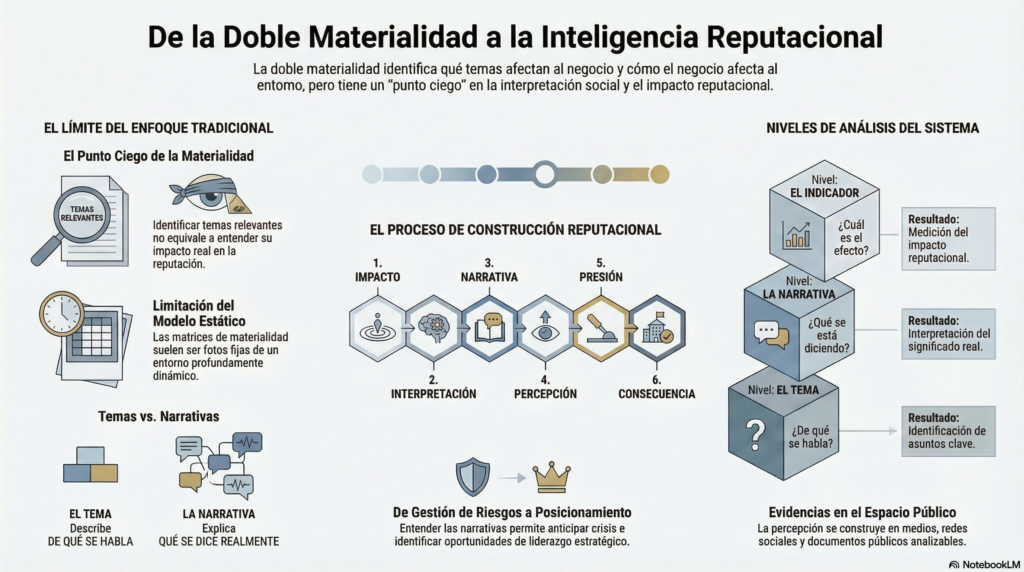
However, this approach has a structural limitation. It is, in essence, a model static applied to an environment that is deeply dynamic. Because the issues themselves have no impact.
They have it depending on how they are interpreted, narrated, and amplified in the public sphere.
The blind spot: between the identified impact and the perceived impact
Between what a company identifies as material and what actually affects its reputation, there is an intermediate layer that is usually left out of the analysis: the perception constructed in public space
That perception is not generated in matrices or workshops.
It is built through:
- media outlets
- social networks
- forums and digital spaces
- reviews and opinions
- reports and public documents
- institutional statements
- including open or qualitative surveys
That is, through textual evidence that expresses how the company's activity is interpreted.
This is where many organizations lose visibility.
They know what issues matter, but they don't know:
- what stories are being told about them
- which attributes are being strengthened or deteriorated
- What reputational dimension is at stake?
- nor how all this evolves over time
From themes to narratives: where corporate reputation is truly built
The same material issue can lead to completely different impacts. The difference lies not in the subject matter, but in the narrative.
For example, a topic like the energy transition can become:
- a narrative of leadership and innovation
- a narrative of opportunism or greenwashing
- a narrative of regulatory pressure
- or a narrative of social conflict
What determines the impact is not the subject matter, but the story that is built around him.
In the Enigmia system, this distinction is structural:
- the topic describes what are we talking about
- the narrative explains what is really being said
- the indicator measures the impact of that narrative
This logic helps us understand why two companies, exposed to the same material issue, can have completely different reputational trajectories.
Reputation as a mechanism connecting impact and business
Dual materiality introduces two levels: impact and business; and corporate reputation is the mechanism that connects them. Because in practice, this is what happens:
impact → interpretation → narrative → perception → pressure → consequence
And that process isn't abstract. It's observable, measurable, and traceable. Reputation isn't a vague opinion. It's the cumulative result of how narratives affect an actor in the public sphere.
Therefore, if a company wants to properly manage its dual materiality, it needs to understand not only which issues are relevant, but also:
- how those themes are being interpreted
- what impact are they having
- and what trajectory are they building?
The necessary leap: transforming dual materiality into reputational intelligence
This is where the traditional approach falls short and where the value of a system like Enigmia comes in.
Enigma does not replace the analysis of double materiality. What it does is to make it operational in public space.
And it does so based on a key idea: Any relevant perception leaves a trace in the form of text, audio, image, or video.
This allows working with a much broader universe than usual:
- media outlets
- social networks
- reviews and opinions
- public documents
- sector reports
- institutional positions
- results of open or qualitative surveys
Everything that can be expressed becomes analyzable evidence. This radically expands analytical capacity. We no longer rely solely on structured surveys or volume metrics. We can directly analyze how perception is being constructed.
How does this translate into real analytical capacity?
Based on this evidence, the system allows for working with dual materiality in a dynamic way.
- Identifying how material issues evolve in public space, not in terms of presence, but in terms of impact.
- Interpreting the narratives that are being built around these themes, understanding which stories dominate and which actors drive them.
- Measuring the reputational impact of these narratives on the organization, not as a sentiment, but as a structured effect on dimensions such as integrity, leadership, or capability.
- Analyzing the evolution over time: persistence, escalation, narrative rotation.
This approach allows something that the traditional model does not offer: moving from a static photo to a dynamic reading of the environment.
From risk management to positioning building
Dual materiality is often approached from a risk-based perspective. But in reality, when handled well, it's also a positioning tool. Because understanding narratives allows us to:
- anticipate crises before they escalate
- identify leadership opportunities
- Strengthen key attributes
- correct harmful narrative frameworks
- and align communication with real impact
It's not just about avoiding problems. It's about to build a position in the public sphere.
In short
Dual materiality has been a decisive step forward in how companies understand their impact, but its real value lies not in identifying issues. It lies in the ability to interpret what those issues mean in the public sphere. That is where many organizations still operate with little visibility.
And that's where a system like Enigmia introduces a fundamental difference: It allows the materiality to be transformed into a structured, continuous, and measurable reading of the reputational and narrative impact.
Or, to put it another way: not only what matters, but what is really happening with what matters.












 Spanish
  English
  Portuguese
  French
  German
  Italian