





We analyze which corporate reputation indicators the market uses, their limitations, and how to evolve towards a real measurement of reputational and narrative impact.
Table of Contents
The corporate reputation It has become one of the most relevant variables for the strategic direction of any organization. It no longer only affects a company's external image. It affects the trust of customers, investors, regulators, employees, and the public. It influences a company's social legitimacy, its leadership capacity, and its real scope for action in complex contexts.
However, although reputation is increasingly prominent in business discourse, its measurement remains insufficient in many cases. When an organization seeks corporate reputation indicators, It is often encountered in a fragmented ecosystem of metrics, tools, and rankings that allow one to observe parts of the problem, but not always to understand it in depth.
For years the sector has worked with useful, but partial, indicators. Some are useful for measure notoriety. Others help assess perception. Still others allow monitoring of public discourse in media and social networks. The problem arises when a company needs to answer more demanding questions: what narratives are shaping its public position, what dimensions of its reputation are being reinforced or eroded, what actors are driving this process, and to what extent is its communication activity translating into real reputational value?.
That's where the difference begins to emerge between traditional reputation measurement and a new generation of models designed to analyze the reputational and narrative impact of an organization in the public sphere. That is precisely the territory in which Enigmia is situated.
What is commonly understood by corporate reputation indicators
When the market talks about corporate reputation indicators, it usually refers to a set of metrics that attempt to approximate the prestige, perception, and public position of a company.
There is no single universal standard. In practice, organizations often combine several families of indicators.
Indicators of notoriety and visibility
These are probably the most widely used metrics in media monitoring, clipping, and social listening tools. They include variables such as the volume of mentions, the share of conversation compared to competitors, potential reach, media presence, and the evolution of public exposure over a given period.
These indicators allow us to measure how often a company appears in the public sphere and with what intensity. They are useful for tracking a campaign, comparing its presence against other players, or detecting peaks in media attention.
Its limitation is clear: visibility is not equivalent to reputation. A company can appear frequently and do so within unfavorable narratives. It can also generate a large volume of conversation without reinforcing any of the attributes that truly underpin its legitimacy or brand value.
Tone or sentiment indicators
Another common approach is to classify mentions as positive, negative, or neutral. This approach has become widespread because it offers a quick snapshot of the overall mood of public discourse.
Even so, sentiment alone rarely captures the reputational complexity of an organization. Seemingly neutral information can reinforce a narrative of conflict, loss of control, or institutional erosion. Similarly, a positive mention may have little relevance if it addresses peripheral issues rather than the strategic attributes that define the company's public standing.
Perception-based indicators
This is where the major reputation monitors come in, supported by multi-stakeholder assessments, surveys, rankings, and more traditional reputation models. These methodologies allow for the creation of a valuable snapshot of how different audiences perceive a company and how it compares to other players.
Their main contribution is that they introduce a more structured view of reputation and connect it to broader criteria than mere media presence. However, they often have a practical limitation: they offer a good reading of reputational status, but they don't always allow for a sufficiently deep understanding of the narrative dynamics producing that result on a daily basis.
Indicators of digital interaction and conversation
In social media, metrics such as engagement, virality, amplification, and participation are also used. These variables help to detect resonance and mobilization capacity.
The problem remains the same. Digital conversation doesn't always equate to reputational impact. There can be a lot of noise without any strategic effect. And there can be narratives with moderate volume but an enormous capacity to erode an organization's trust, authority, or legitimacy.
The problem with the traditional approach
All these approaches have value. It would be a mistake to dismiss them. The problem arises when they become the final destination of the analysis and not just another layer within a more ambitious interpretive framework.
Most of the market continues to measure primarily communicative activity, information intensity, exposure, or aggregate perception. But that doesn't always allow us to understand how reputation is built in the public sphere or how it evolves cumulatively.
This gap is precisely what Enigmia identifies in its model. Its approach stems from a clear idea: many tools describe the conversation, but they don't rigorously explain the reputational and narrative impact that this conversation generates on organizations, brands, or leaders.
The difference is important. Describing the conversation reveals what's happening. Measuring its reputational impact reveals the strategic consequences of what's happening.
It's not the same to register many mentions as it is to know which narratives are reinforcing or eroding trust in a company. It's not the same to see an increase in media noise as it is to understand which specific attributes are being questioned. It's not the same to measure communication activity as it is to measure whether that activity actually improves the organization's public image.
What should a company really measure?
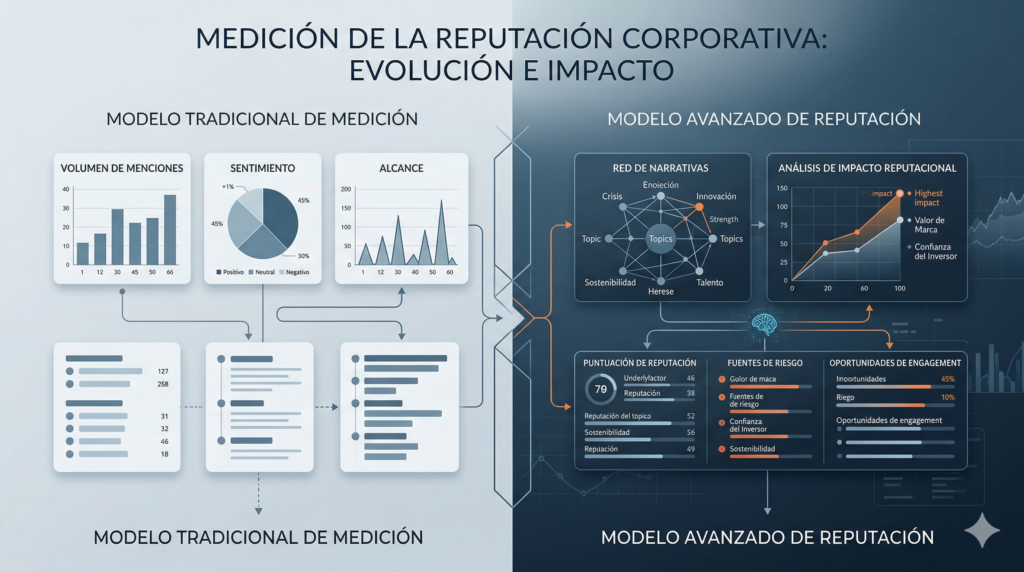
If an organization wants to treat reputation as a strategic variable and not just as an aspirational notion, it needs a system of indicators capable of going beyond mere observation.
1. The reputational impact of narratives
A company needs to know not only how much is being said about it, but What reputational effect do the surrounding information and narratives have?.
This analysis allows us to differentiate between presence and effect. It also allows us to identify which narratives, themes, media outlets, or actors are driving the improvement or deterioration of their public standing.
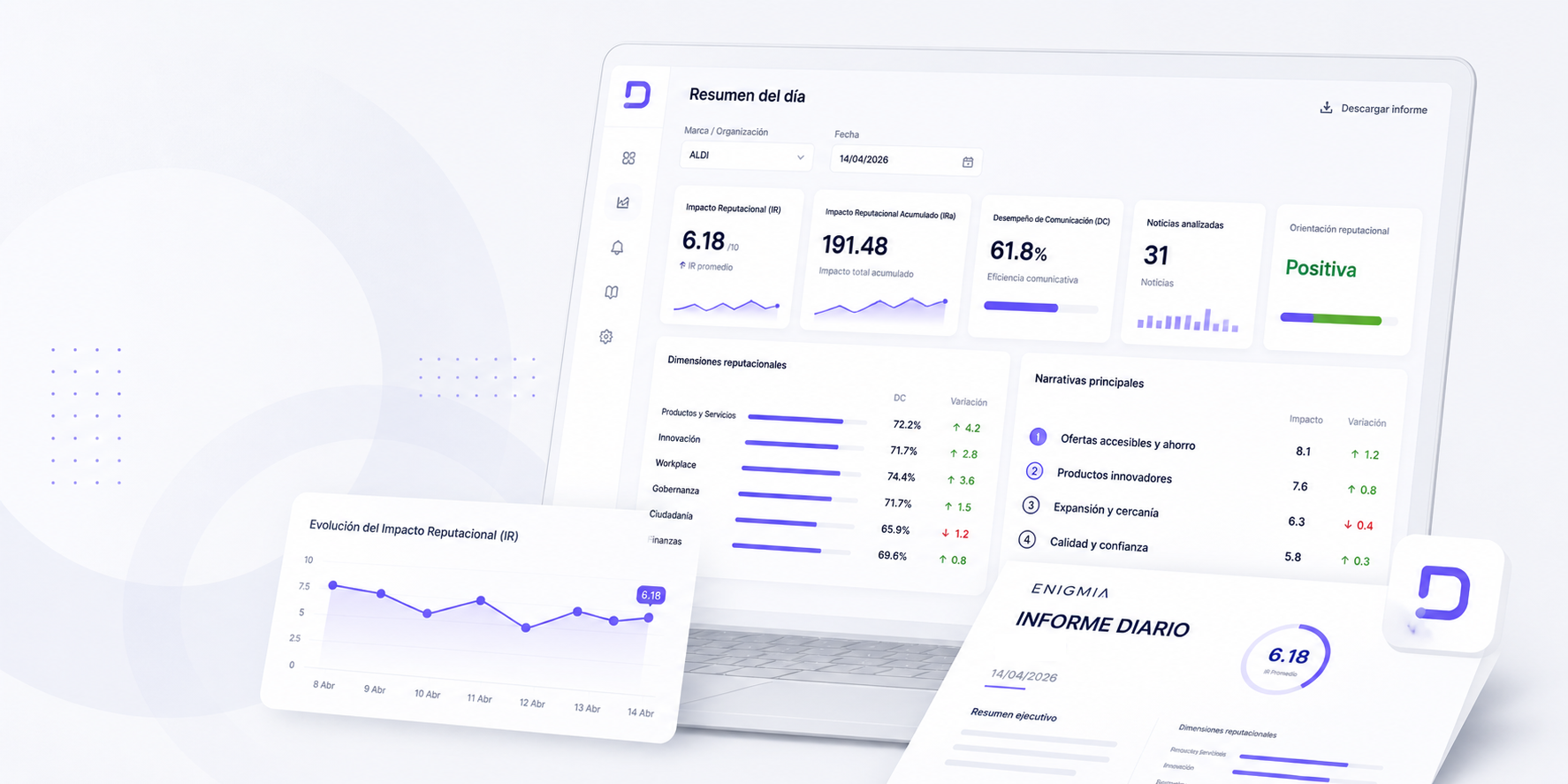
In the Enigmia model, this dimension is addressed through the indicator of Reputational Impact (RI), designed to measure the reputational effect that information or a narrative produces on an organization or actor.
2. The evolution of reputation over time
Reputation is not built solely from isolated impacts. It is consolidated, eroded, or transformed through the accumulation, persistence, and repetition of narratives.
That's why taking a single snapshot isn't enough. It's necessary to analyze the trajectory.
Enigmia presents this logic through the Cumulative Reputational Impact (IR(a)), This approach integrates the reputational quality of each impact, the volume generated, and the temporal persistence of the narratives. It allows for the analysis of phenomena such as the accumulation of crises, the consolidation of positive reputation, and structural changes in public perception.
3. The real effectiveness of communication
One of the major shortcomings of traditional measurement is that many companies can demonstrate activity, but they cannot always demonstrate reputational effectiveness.
The relevant question is not just how much an organization communicates, but to what extent it manages to transform that exposure into an improvement in its positioning.
In the Enigmia system, this dimension is addressed through the indicator of Communication Performance, This metric compares the cumulative reputational impact achieved with the potential that could have been reached with the same level of public exposure. In other words, it measures not just presence, but the ability to convert visibility into reputation.
4. The dimensions and attributes that sustain reputation
Reputation is not a homogeneous entity. Organizations are evaluated based on different dimensions: management capacity, leadership, integrity, innovation, social commitment, approachability, vision for the future, and governance, among others.
Therefore, advanced measurement needs to work with specific reputational dimensions and analytical attributes. Only in this way is it possible to identify which aspects of reputation are improving, which are weakening, and what factors are explaining this trend.
Enigmia's analytical model is built precisely on that multidimensional logic, combining dimensions, attributes, and semantic analysis to transform large volumes of public information into interpretable reputational knowledge.
5. The role of narratives in building reputation
Reputation doesn't depend solely on abstract assessments. It's built through narratives. These narratives articulate interpretive frameworks, connect the organization to specific values, and shape how different audiences understand its role in the public sphere.
That's why simply measuring tone isn't enough. It's necessary to analyze meaning, context, relationships between actors, dominant themes, and the evolution of discursive frameworks.
This is one of the most relevant contributions of the Enigmia approach: not limiting itself to classifying mentions, but interpreting how the narratives that affect the reputation and positioning of the actors analyzed are constructed.
The natural evolution of the sector
In recent years, the market has made significant progress in monitoring, data capture, social listening, and automated trend identification. This progress has been useful and necessary. But it has also highlighted a limitation: observing the conversation is not the same as understanding its strategic impact.
That's where a natural evolution of the sector emerges.
More mature organizations no longer just need tools to know what is being said. They need systems that allow them to interpret how media, social, and regulatory dynamics affect their legitimacy, positioning, and ability to act.
That's the space in which Enigmia defines its proposition. We're not a software company, a communications consultancy, or a media analytics firm, but rather a company that... Measurement and intelligence of reputational and narrative impact in the public sphere.
This implies a change of approach:
- It involves moving from monitoring to strategic intelligence.
- It involves moving from isolated data to a system of indicators.
- It involves moving from descriptive monitoring to the ability to explain, compare, and anticipate.
What does a model like Enigmia's offer?
The value of a proposal like Enigmia's lies not only in offering more data, but in better structuring the analysis.
Their system integrates three dimensions that appear separate in many traditional approaches: reputation, communicative effectiveness, and public identity or symbolic capital of the actors.
This allows us to answer questions that are rarely well resolved with conventional tools:
- what narratives are shaping an organization's public position,
- which media, sources, or actors are driving a particular impact,
- which reputational attributes are gaining or losing importance,
- how a crisis or a reputational improvement evolves over time,
- to what extent is a company leveraging its public exposure,
- and how it defensibly compares with competitors or industry benchmarks.
Furthermore, the system is designed to maintain methodological consistency and comparability, two fundamental elements when a company wants to analyze trends, build benchmarks, or support strategic decisions with solid criteria.
So, what are the corporate reputation indicators that really matter?
Those indicators that allow connecting public discourse with decision-making are important.
This means an organization shouldn't settle for metrics like activity, visibility, or tone. Those layers are still useful, but they need to be integrated into a more comprehensive framework.
The indicators that really matter are those that allow us to measure:
- the quality of the reputational impact of the narratives
- the accumulated reputational evolution
- the effectiveness of communicative activity
- the attributes that shape the public identity of the organization or its leaders
- the narrative frameworks that explain the transformation of their position in the public sphere
In other words, it's not about ceasing to measure mentions, notoriety, or perception. It's about ceasing to think that's enough.
In short
The search for corporate reputation indicators It usually starts with familiar metrics: visibility, tone, share of voice, rankings, or aggregate perception. All of these provide useful information. But a company that wants to manage its reputation strategically needs to go further.
It needs to understand not only how often it appears, but what impact that appearance has. Not only how different audiences perceive it, but what narratives are shaping that perception. Not only how much communication activity it engages in, but whether that activity is translating into reputational value and public positioning.
This marks the beginning of a new era in reputation measurement. It's a stage where reputation ceases to be treated as an abstract concept or a scattered set of metrics, and instead becomes a more structured, explainable, and useful object of analysis for strategic management.
That is precisely the territory that Enigmia has decided to occupy: that of the Measurement and intelligence of reputational and narrative impact, integrating semantic analysis, a proprietary system of indicators and strategic reading of public space to help organizations, institutions and leaders understand how their public position is actually built.
At Enigmia, we help organizations and institutions measure how public narratives affect their reputation, positioning, and ability to act. If you want to understand what's truly driving your public impact, we can help you analyze it with a system of indicators designed to go beyond traditional monitoring.












 Spanish
  English
  Portuguese
  French
  German
  Italian