






Social media influence is one of the most used—and most misunderstood—concepts in marketing and communication.
For years, it's been assumed that influence consists of having a large audience and generating interaction. The more followers, likes, and comments, the greater the influence.
However, the reality is much more uncomfortable: Many profiles with very high numbers have no influence on anything relevant., while others, much smaller, are capable of changing conversations, positioning ideas, or even influencing decisions.
This raises a key question: Are we really measuring influence or just its appearance?
Article index
What the market understands by influence (and why it falls short)
When a brand analyzes its social media influence, it usually focuses on a fairly limited set of metrics:
- number of followers
- engagement (likes, comments, shares)
- scope and impressions
- audience growth
These metrics are useful for understanding activity and visibility, However, they have a structural limitation: They describe what happens, but they don't explain what causes it. And that's the problem.
Because influence is not about how much content is shared, but about the effect it generates.
The fundamental error: confusing visibility with influence
The market has built a relationship that seems logical: More reach = more influence
But in practice, it doesn't work that way. Content can go viral, generate thousands of interactions, and disappear the next day without anything relevant having changed.
- It does not alter perceptions.
- It doesn't alter the conversation.
- It doesn't position anyone.
Meanwhile, other content with less visibility may:
- introduce an idea that others begin to replicate
- change the focus of a debate
- to strengthen or damage a brand's image
Now that's influence!. The key isn't volume. It's the impact that remains.
What exactly is social media influence?
If we remove the noise from superficial metrics, the influence can be understood much more accurately: To influence is to get something to change after you appear.
That change could be:
- how a brand is perceived
- how to interpret a topic
- what is said in a conversation
- or even what decisions are made
This implies a significant change of approach:
- It's not about how many people see you
- but of how much you change what others think or do
Influence is not exposure. It is effect.
Why engagement doesn't measure real influence
Engagement has become the star metric because it's easy to measure and easy to explain. But it has an obvious limitation. It measures:
- reaction
- attention
- interaction
But it doesn't measure:
- change of perception
- positioning construction
- reputational impact
- ability to mark conversation
A piece of content can generate thousands of interactions and have no strategic effect. It's activity, not influence.
And this difference explains why many campaigns with good numbers do not generate real results.
How to measure real influence on social media

Measuring the influence It really involves a complete change of approach.
It's not about adding more metrics, but about looking at other things.
1. The impact you have on perception
The first question is not whether you like it, but how do you position.
- Do you reinforce trust?
- Do you generate credibility?
- Are you introducing doubts?
Influence begins when you change the perception of an actor in the minds of others.
2. Your ability to generate or change narratives
There are profiles that participate in the conversation. And others that define it. The difference is clear:
- some react
- Others set the framework
When others begin to speak in the terms you have introduced, there is real influence.
3. The prominence you have when you appear
Being present is not the same as being relevant.
You can appear a lot… and have no weight.
Or appear less… and be the central actor when you do.
The influence has more to do with that real prominence than with frequency.
4. The persistence of your impact
Virality is immediate. Influence is cumulative. Content that disappears in hours can generate noise. Content that reappears, replicates, and persists over time generates influence.
If what you say is still present days later, you have generated a real impact.
5. The value you generate
Not all impact is the same. Some examples:
- build brand
- They generate trust.
- open up opportunities
Others simply generate empty conversation. Measuring influence also involves understanding What value does what you cause have?.
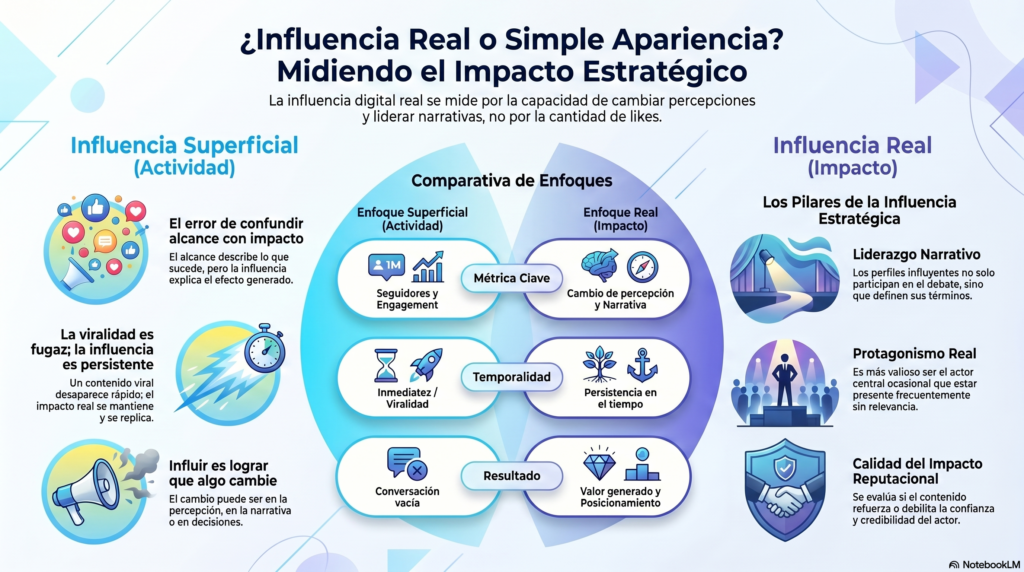
Superficial influence vs. real influence
The difference between the two approaches can be summarized as follows:
| Surface influence | Real influence |
|---|---|
| Followers | Impact on perception |
| Engagement | Narrative ability |
| Scope | Leadership |
| Virality | Persistence |
| Activity | Value generated |
What does this mean for brands and companies?
This change in focus is not theoretical. Many brands are investing in profiles with:
- high visibility
- high engagement
but with a limited capacity to generate real impact.
This translates to:
- ineffective campaigns
- poor budget allocation
- difficulty in justifying results
Because they are measuring activity well… but not influence.
The evolution: measuring influence as impact
Increasingly, the measurement of influence is evolving towards models that integrate:
- reputational impact
- narrative analysis
- communicative effectiveness
- value of communication
This approach allows us to understand not only how much an actor is talked about, but What effect does that conversation have, and what value does it have?.
How Enigmia approaches measuring real influence on social networks
The fundamental problem in measuring influence on social networks is not the lack of data, but the lack of a framework that allows for its correct interpretation.
Enigmia starts precisely from that point.
Instead of measuring activity—as most tools on the market do—their approach focuses on interpret the impact that this activity generates in public space. This implies a complete change in the logic of analysis. In practice, the Enigmia model integrates three layers that allow for a structured measurement of influence:
1. Narrative interpretation of the content
Each piece of content is analyzed not only for what it says, but also for the narrative that activates:
- what story is he building
- From what framework does he/she interpret reality?
- how it positions the actor within that story
This allows us to understand the meaning of the content before measuring it.
2. Measuring reputational impact
Based on that narrative, an evaluation is made what effect does it have on the actor:
- whether it strengthens or weakens its positioning
- which attributes are affected
- what quality does that impact have?
This approach avoids one of the most common mistakes in the market: using sentiment or engagement as substitutes for impact.
3. Evaluation of the effectiveness and value of communication
Finally, the model allows us to understand two key aspects:
- to what extent is an actor leveraging their presence to generate impact
- What economic value does that impact have on the market?
This introduces a differential layer: not only is the influence measured, but its real capacity to generate value.
What changes with this approach?
This model allows us to move from a measurement based on isolated metrics to a structured reading of influence.
Instead of asking:
- How many followers does a profile have?
- how much engagement it generates
It allows us to answer much more relevant questions:
- what impact is it really having
- what narratives is it building
- how its influence evolves over time
- What value does that influence have in business terms?












 Spanish
  English
  Portuguese
  French
  German
  Italian