





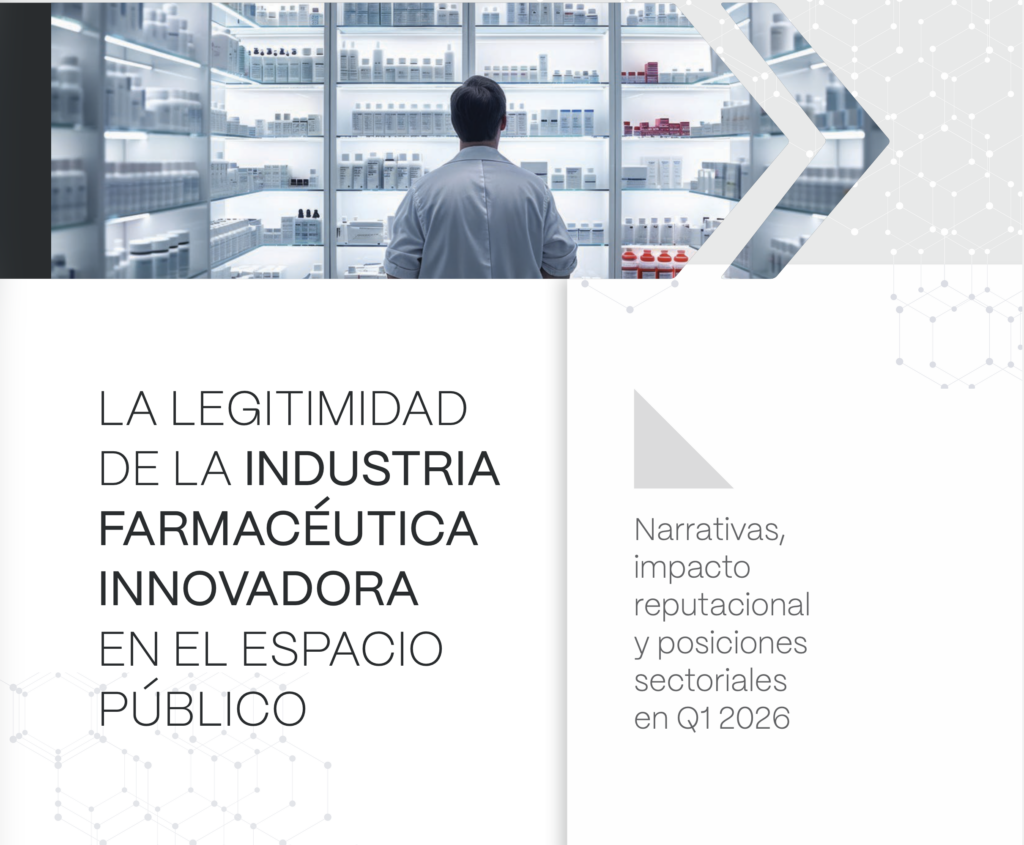
The innovative pharmaceutical industry It occupies a unique position in the public sphere. Its activity is linked to science, health, investment, research, medical innovation, and improving patients' lives. But it also operates in a particularly demanding environment, where regulation, drug prices, patents, access, business competition, and public trust constantly condition its legitimacy.
In this context, the reputation of the sector does not depend solely on how much a company appears in the media or the intensity of its public presence. It depends, above all, on how is it represented, what narratives are activated around it and what kind of reputational impact it accumulates over time.
The report “The legitimacy of the innovative pharmaceutical industry in the public sphere”, The report, prepared by Enigmia, analyzes how the public conversation of the sector has been constructed during the first quarter of 2026. Its objective is not to summarize headlines or order mentions, but to interpret which stories are shaping the public legitimacy of innovative pharma in Spain.
Visibility is not reputation
One of the main lessons learned from the report is that Visibility alone does not build legitimacy..
Financial discourse, business results, corporate transactions, and market movements lend presence and prominence. They position companies within the competitive landscape and reinforce their perception as relevant economic players.
But that visibility doesn't always translate into a more robust reputation.
Enigmia's analysis shows that the narratives with the greatest capacity to build legitimacy are those that connect the sector's activity with two especially valuable dimensions: concrete innovation y visible social utility.
Innovation builds reputation when it ceases to be presented as an abstract capability and translates into clinical advances, therapies, applied technologies, or understandable solutions. Social utility emerges when that innovation connects with patients, prevention, health education, public health, or makes a recognizable contribution to social well-being.
Therein lies the most fertile ground for the reputation of innovative pharmaceuticals.
The double lever of legitimacy: concrete innovation and social utility
The pharmaceutical industry typically places innovation at the heart of its narrative. However, not every conversation about innovation has the same reputational impact.
A company may appear to be associated with research, investment, or scientific development and still fail to build a particularly strong public position if that innovation is not understandable, applicable, or socially relevant.
The report identifies a clear pattern: reputation is strengthened when science becomes visible and when progress is interpreted as a real contribution.
This shifts the focus of the analysis. The question is not just whether a company innovates, but how is that innovation publicly interpreted?. If it appears as an abstract promise, its reputational impact is limited. If it appears linked to patients, treatments, prevention, or tangible improvement, its ability to build legitimacy increases.
In regulated sectors with high public exposure, this difference is decisive.
A fragmented sectoral leadership
The report also shows that the reputational leadership of innovative pharma is not distributed evenly.
There is no single, absolute leader in the sector. What emerges is a map of differentiated positions, where different companies are better suited to different narrative territories.
Some companies excel in concrete innovation. Others focus more on social benefit. Still others gain prominence through market share and results. And some project broader legitimacy by associating themselves with ecosystems, talent, collaboration, and institutions.
This reading is important because it avoids a simplified view of reputation.
It's not enough to ask which company appears most often. The relevant question is what kind of public position is each actor building and on what narrative is that position based?.
In this sense, the report allows us to read the sector as a competitive map of legitimacy: who leads each territory, which companies accumulate the greatest reputational impact, and what narrative frameworks are reinforcing or limiting their position.
Governance, litigation and controversy: the most fragile territory
The main area of fragility detected in the quarter does not stem from a general crisis in the sector, but from those frameworks where the conversation shifts towards governance, litigation, patents, dispute or controversy.
In these territories, visibility loses its ability to become reputational value.
The company continues to appear in the public sphere, but the framing no longer works in its favor. The conversation no longer reinforces scientific capacity, social utility, or institutional leadership, but instead places the actor in a more reactive, narrower, and less productive framework.
This point is especially relevant for communications, reputation, and public affairs teams. Reputational risk doesn't only arise when negative rhetoric intensifies. It also emerges when a narrative begins to solidify in a way that diminishes the company's ability to explain its value.
Therefore, reputation analysis needs to go beyond the volume of mentions or sentiment. It must interpret which narratives are gaining traction, which reputational dimensions they affect, and what impact they may have on the company's public standing.
From clipping to reputational intelligence
The report applies the Enigmia Reputation approach: transforming large volumes of public information into structured knowledge for decision-making.
Enigmia does not analyze public discourse as a sum of mentions. It interprets it as a system of narratives, actors, attributes, and indicators that shape reputational positions with real effects on an organization's legitimacy, trust, and capacity to act.
Through the Reputational Impact and from Cumulative Reputational Impact, Enigmia allows us to differentiate between presence and impact, between public activity and reputational value, between situational notoriety and sustained construction of legitimacy.
This approach is especially useful in sectors such as pharmaceuticals, where public discourse is multi-layered: science, patients, innovation, regulation, market, access, controversy, institutions, and social trust.
What does this report contribute?
The report allows us to understand:
- What narratives are building the most reputational value for innovative pharma?.
- Which companies best occupy each narrative territory?.
- Where are the main areas of fragility in the sector located?.
- Why financial visibility does not always translate into legitimacy.
- What signs should we follow in the coming quarters?.
Its usefulness lies not only in the snapshot of the first quarter of 2026, but also in the possibility of turning this reading into a continuous monitoring system.
Updating this analysis on a quarterly basis would allow us to observe the evolution of narratives, detect changes in position, anticipate risks, and differentiate between cyclical movements and dynamics that are beginning to consolidate.
Download the full report
The reputation of an innovative pharmaceutical industry is not determined solely by the intensity of its public presence. It is built on the quality of the narratives that represent it, on its ability to make its innovation understandable, and on how it connects its activity to a recognizable social benefit.
The Enigmia report offers a structured reading of that reputational construction in Spain during Q1 2026.
Complete the form to download the full report.










 Spanish
  English
  Portuguese
  French
  German
  Italian