




Table of Contents
The media analysis has become an essential tool for any organization that needs to understand how their public position is built. For years, many companies were content with knowing where they appeared, how many times were they mentioned or what volume of coverage they generated. Today that's no longer enough.
The issue is no longer just to be present in the media, but to understand What is the meaning of that presence?, what stories activates y what effect does it produce about the perception of a company, a brand, or a leader.
This change is important because public information no longer functions solely as a reflection of reality. It also acts as a space where priorities are ordered, narratives are consolidated, responsibilities are assigned y frameworks of interpretation are configured that affect the reputation, legitimacy, and positioning of the organizations.
That's why talking about media analysis It's not just about news monitoring. It's about a much more valuable capability: to interpret in a structured way what is happening in public space.
What is media analysis?
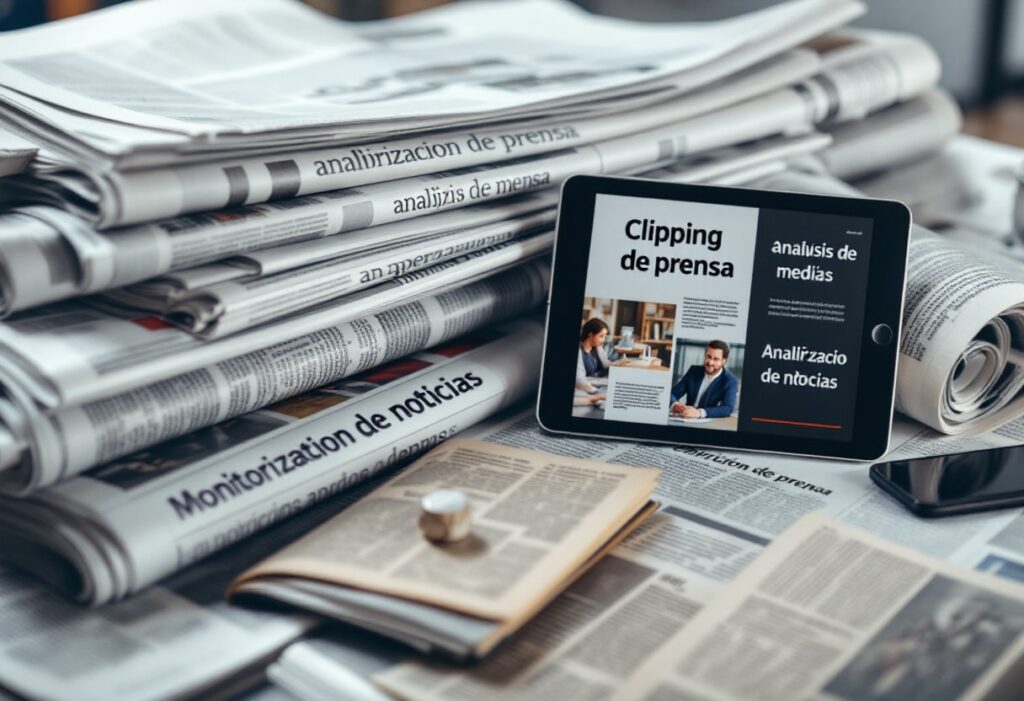
The media analysis It is the process by which an organization systematically examines the information published in press, radio, television, digital media and other news outlets to understand how a topic, an actor, or a particular reality is presented.
It's not just about compile content. It consists of interpret them.
A well-designed media analysis allows for the study of issues such as the approach taken to an organization, the topics that dominate its coverage, the attributes associated with it, the actors who influence their public representation y the evolution of all of this over time.
In other words, media analysis is not limited to answering where we appear. It answers, above all, questions like these: how are we being represented, that narrative frameworks They are consolidating, What issues explain our public presence? y What implications does that conversation have for our position?.
What is the purpose of media analysis?
The usefulness of media analysis goes far beyond simply keeping up with current events. Its true value emerges when it allows transform scattered information into useful knowledge for better decision-making.
It serves, first of all, to understand how public conversation circulates around an organization, a sector, or a relevant issue. It also helps to detect which issues are gaining prominence, which approaches are repeated, which spokespeople or actors influence the debate y What are the differences between one medium and another?.
Furthermore, it allows identification emerging risks, anticipate changes in the news climate and to understand if an organization's public visibility is generating a position favorable, neutral, or problematic.
For the teams of communication, public affairs, reputation, or management, This is especially important. It's not just about watching the news, but about having a orderly reading of the environment to guide messages, adjust decisions, and better understand the context in which the organization operates.
Media analysis is not the same as monitoring
These two concepts are often confused, but They are not exactly the same.
The media monitoring focuses on locate, compile and organize relevant mentions or content through a clipping service. It's a necessary layer, because without it there's no raw material to work with. But on its own no interpretation.
The media analysis It starts later. It begins when that information It is classified, contextualized, and interpreted to draw conclusions.
That difference is key. An organization can have thousands of mentions collected And yet, not truly understand what's happening in their public environment. They may know how much appears, but not What story is defining her?. You can find out about volume, but not the sense. It can measure the exposure, but not the impact.
Therefore, when seriously discussing media analysis, simply gathering information is no longer enough. One must be able to read it with discernment.
What does a good media analysis really examine?
A useful media analysis doesn't stop at the appearance count. Observe multiple layers at once.
Analyze, for example, the topics that dominate the coverage and the hierarchy they receive. It's not the same to appear linked to results, innovation or growth that to regulatory conflict, crisis or controversy.
He also studies the narrative approach of the content. That is, from what framework is an organization presented: as a reference, as a problem, as a questioned actor, as a driver of change, as a distant company o as a solvent company.
This is in addition to the observation of attributes. The media doesn't just talk about facts; it also project qualities. In their stories they can reinforce ideas of leadership, ability, integrity, approachability, innovation, or social commitment, among others.
A comprehensive media analysis also pays attention to the sources, to the actors involved, to comparisons with competitors, to territorial and sectoral differences and to temporal evolution of those dynamics.
When all of this is properly arranged, the organization stops looking isolated parts and begins to understand how their position in public space is being configured.
How to do a media analysis with sound judgment
Conducting a valuable media analysis requires, first and foremost, formulate the question well. Analyzing the general public perception of a company is not the same as studying how it is being represented. a concrete decision, a crisis, a change in management o a sectoral debate.
From there, the first step is to define clearly the universe of sources. This involves deciding which media are relevant, which geographical areas should be included, which industry publications should be included and if it makes sense to add other spaces, such as institutional communications, specialized blogs o networks where relevant narratives also circulate.
The second step is to ensure the quality of the analyzed material. In any serious job, you need remove duplicates, distinguish republications, order mentions and always keep traceability to the original source.
Then comes the decisive part: the interpretation. That's where they are identified. topics, narrative frameworks, dominant attributes, influential actors, differences between media y trend changes.
Finally, the analysis must conclude on useful conclusions. It is not enough to describe what has been seen. It is necessary to explain. what does it mean, what risks or opportunities it reveals y what decisions can it help guide.
What questions should a media analysis answer?
A good media analysis should help answer, at the very least, some fundamental questions.
- What topics They explain the public presence of an organization.
- What narrative frameworks They are dominating their representation.
- What attributes positive or negative results appear associated with their name.
- What media or actors They are having more influence on that construction.
- How it evolves that coverage over time.
- What differences exist? compared to competitors or comparable actors.
And, above all, what are the implications of all this? for the organization's reputation, positioning, and performance capabilities.
In reality, the value of media analysis lies there: in its ability to move from the observation to the comprehension.
Why media analysis is key to reputation
The reputation It is not built in the abstract. It is configured through perceptions, narratives, associations, and judgments that circulate in public spaces. And the media continue to play a central role in that construction.
Therefore, media analysis is not just an informative task. It is a way to understand. how certain dimensions of reputation are strengthened or eroded of an organization.
A company can appear very prominently and be harmed if the coverage reinforces a narrative of conflict, mistrust, or lack of control. And it can also have a smaller, but much more valuable, presence if the content places it within frameworks of solvency, innovation, leadership or credibility.
From this perspective, media analysis functions as a reputational reading tool. It allows identification what is reinforcing the public position of an organization and what is weakening it.
What mistakes should be avoided?
One of the most frequent mistakes is confusing quantity with understanding. Accumulating news is not the same as analyzing media.
Another common mistake is working without context. An isolated mention may seem relevant, but it only makes sense when compared with other content, other actors y other dynamics of the debate.
It is also a common mistake to stay in the positive or negative tone as the sole logic of interpretation. That simplification is insufficient for understanding complex narrative frameworks, projected attributes or debates where an organization can have a lot of visibility without that translating into a good public position.
Finally, many organizations make the mistake of not connecting the analysis with real decisions. A useful media analysis shouldn't end with a report that is filed away. It should serve as a guide. communication, reputation, public affairs, positioning and risk assessment.
Media analysis as a strategic tool
In an information-saturated environment, true value is no longer in access more content, but in power interpret them better.
Therefore, media analysis has ceased to be an auxiliary task and has become a strategic capacity. It allows us to understand how the environment evolves, detect narrative shifts, anticipate tensions, compare positions and to provide the organization with a more sophisticated interpretation of its public presentation.
This is especially relevant in contexts where the reputationthe regulationthe leadership wave social legitimacy They directly influence the activity of organizations. In these scenarios, analyzing media is also analyzing context, influence, and positioning ability.
Conclusion
The media analysis It can no longer be understood as a simple news review. It is a tool for interpreting public space, understand how stories are constructed that affect an organization and extract useful knowledge for decision making.
Compared to more limited approaches, focused only on compile mentions o measure volume, Media analysis allows us to understand themes, narratives, attributes, comparisons, and temporal evolution. In other words, it allows you to read in depth what the media are saying and, above all, what that means.
In a context where reputation and positioning increasingly depend on how decisions and actors are publicly interpreted, having this analytical capacity is essential. makes a real difference.












 Spanish
  English
  Portuguese
  French
  German
  Italian