






In this article
For years, measuring media impact has relied on indicators such as the number of appearances, potential audience, estimated reach, or advertising value equivalent. These metrics remain useful for describing the exposure of a brand, institution, campaign, or sponsorship, but they don't always answer the most important question: what real value has that presence generated in public space.
Measuring media impact is not just about knowing how much an organization has been talked about. It involves understanding how it appeared, with what prominence, in what context, what narratives has it activated and what effect that coverage may have on its reputation, its positioning or its ability to generate communicative value.
In an environment where corporate communications, advertising, sponsorship, and branding initiatives compete for public attention, the measurement of media impact needs to evolve. Simply counting mentions is no longer enough. It's necessary to interpret the meaning of these appearances and translate that meaning into actionable insights for decision-making.
What is media impact measurement?
Measuring media impact is the process of analyzing the presence of an organization, brand, person, campaign, event, or sponsorship in media and other public spaces to determine the effect of that exposure.
At its most basic level, this measurement allows you to know how many times a brand appears, in which media, with what estimated reach, and during what period of time. But a more advanced measurement must go beyond mere presence and analyze the quality of the impact generated.
Not all appearances are created equal. A minor mention in a low-interest news story cannot be interpreted in the same way as a prominent appearance in a relevant media outlet, associated with a favorable narrative and aligned with the attributes an organization wants to cultivate.
Therefore, the relevant question is not only: How often have we appeared?
The truly strategic question is: What has built that presence?
That difference marks the step between a descriptive measurement of media impact and a measurement oriented towards reputation, communication and value.
Why measuring only appearances or audience is insufficient
Many organizations are still evaluating their media presence based on volume indicatorsNumber of impressions, mentions, news articles published, cumulative audience, or potential reach. This data is necessary, but not sufficient.
Volume indicates exposure, not impact. A campaign can generate many mentions and yet not clearly contribute to brand positioning. Similarly, an organization can appear frequently in the media, but within narratives that do not reinforce its strategic objectives.
The potential audience also has its limits. It allows us to estimate the size of the exposure, but it doesn't explain whether that exposure has been favorable, relevant, or useful. A high-profile appearance can have little value if the brand is only mentioned tangentially, if the message isn't aligned with its strategy, or if the coverage doesn't generate any differentiating attributes.
Something similar happens with tone. Classifying a news item as positive, negative, or neutral can be useful as a first impression, but tone is not synonymous with reputation. A seemingly neutral piece can reinforce an unfavorable narrative, and a positive piece may have little value if it doesn't affect any strategic positioning.
Measuring media impact must integrate all these levels: presence, visibility, prominence, context, narrative, reputation, and communicative value.
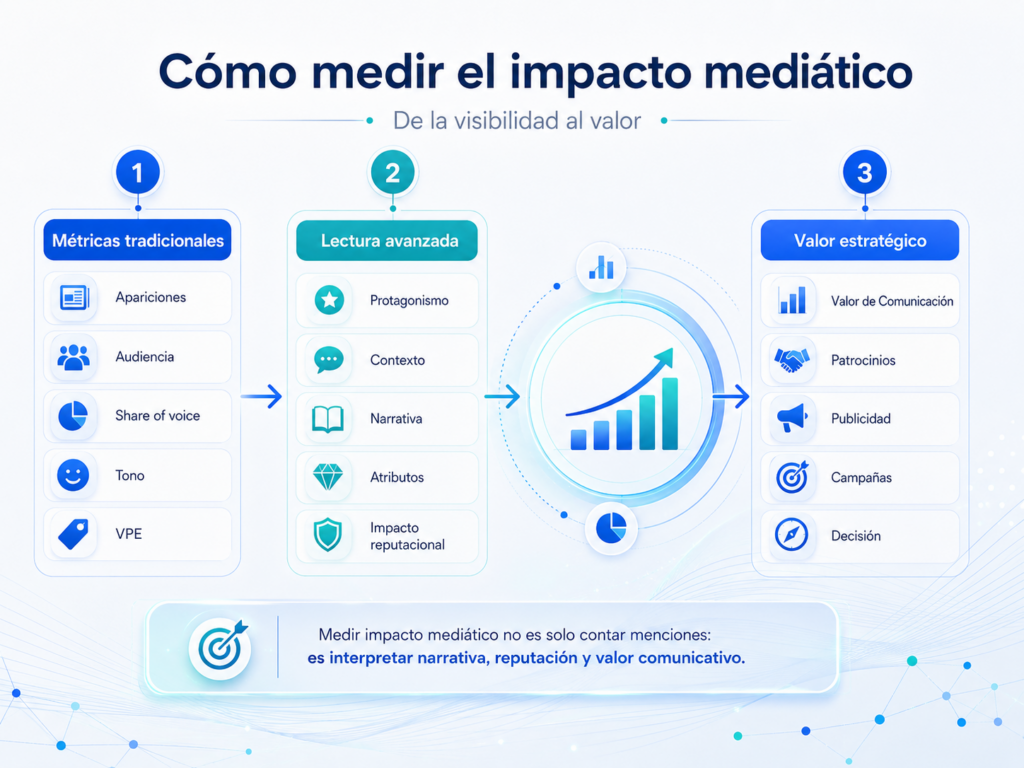
Traditional indicators for measuring media impact
There are several indicators commonly used to measure media presence. Each one contributes to the overall picture, although none should be interpreted in isolation.
Number of appearances or mentions
It is the most basic indicator. It allows you to know how many times a brand, person, institution, or campaign appears in the media during a given period.
Its main purpose is to quantify presence. However, it does not, on its own, allow us to assess whether that presence has been relevant, positive, strategic, or distinctive.
A brand can have many mentions and a low impact if it appears in a secondary role, in irrelevant media, or within content that does not add value to its positioning.
Potential audience or estimated reach
The potential audience allows you to estimate how many people could have been exposed to a news story or piece of content. This is useful for scaling coverage, especially for campaigns, sponsorships, events, or communication initiatives.
Its main limitation is that it measures potential exposure, not actual effect. The fact that a news story reaches many people does not necessarily mean it has generated communicative, reputational, or commercial value.
Share of voice
Share of voice measures the relative weight of a brand or actor compared to other competitors within a given conversation, sector, or period.
It is especially useful in comparative analyses because it reveals which actor has the greatest media presence. However, it must be complemented with a qualitative analysis: having more media presence than competitors does not always mean occupying a better public position.
Coverage shade
Tone analysis classifies media coverage as positive, negative, or neutral. It is a common metric in communications reports and media monitoring.
Its usefulness is obvious, but it has a significant limitation: the tone doesn't fully explain the reputational impact. To understand the quality of the impact, it is necessary to analyze what narrative is activated, what attributes are associated with the brand, and what role the actor plays within the piece.
Leadership
Prominence measures the centrality of the actor within the content. It is not the same to be the main subject of a news story as to appear as a secondary or contextual reference.
This indicator is especially important for interpreting media impact because it helps distinguish between real presence and residual presence. A brand may appear in many pieces but have little prominence in them. In that case, its ability to build public position will be limited.
Advertising Value Equivalent or VPE
Advertising value equivalent estimates how much it would have cost to achieve a similar level of advertising presence through advertising investment. It is a widely used metric in communications, public relations, sponsorship, and events.
The VPE can be useful as an economic benchmark, especially when you want to translate media coverage into language understandable to marketing, business, or management teams. But it has a clear limitation: it doesn't, on its own, explain the quality of the impact generated.
An appearance can have a high VP and yet contribute little strategic value if it does not reinforce the brand reputation, if it does not generate a relevant narrative or if it does not contribute to differentiating it from its competitors.
From VPE to Communication Value
The VPE answers a specific question: How much would it have cost to buy a similar media presence?
It's a useful but limited question. Advanced measurement of media impact needs to answer a more strategic question:
What is the actual capacity of a brand, person, campaign, or sponsorship to generate communicative impact with economic value?
This is where the Communication Value.
In the Enigmia system, Communication Value is an indicator that estimates, in economic terms, an actor's capacity to generate communicative impact in the public sphere. It is not limited to translating media appearances into euros, but incorporates a broader interpretation of the impact generated.
Communication Value can be related to traditional metrics like VPEP because it also allows for expressing part of the impact in economic terms. However, it operates according to a different logic. While VPEP calculates an advertising equivalent, Communication Value seeks to estimate the capacity to generate communicative impact by integrating different layers: media presence, owned media, interaction, and the reputational quality of the impact.
This difference is key.
A brand doesn't generate communicative value simply by appearing frequently. It generates it when its public presence activates relevant narratives, reinforces strategic attributes, gains prominence in appropriate contexts, and contributes to building a differentiated position.
Measuring the media impact of campaigns, advertising, and sponsorships
Measuring media impact is especially relevant in campaigns, sponsorships, advertising actions, events, collaborations with ambassadors or brand activations.
In these cases, organizations often invest significant resources to gain visibility. But visibility doesn't always equal a return. A campaign can have extensive coverage and still fail to generate a communicative impact proportional to the investment made.
Therefore, an advanced measurement should answer questions such as:
- What visibility has the action generated?
- In what media, formats, and contexts has it appeared?
- Has the brand been a protagonist or a supporting character?
- What narratives have been activated around the campaign?
- What attributes have been associated with the brand?
- Has there been a reputational transfer between sponsor and sponsored party?
- What communicative value has been generated?
- Does the return justify the investment made?
In sponsorship, this understanding is especially important. The value of a sponsorship doesn't depend solely on the event's audience or logo exposure. It also depends on the meanings exchanged between the sponsored party and the sponsor.
A brand that sponsors a sporting, cultural, or social event isn't just looking for visibility. It's seeking to associate itself with specific values, narratives, and audiences. Therefore, measuring the media impact of a sponsorship requires analyzing both the coverage generated and the quality of the association built.
The same applies to advertising and brand campaigns. Media impact should not be measured solely as the noise generated, but as its capacity to build positioning, reinforce attributes, and generate communicative value.
What should an advanced measurement of media impact include?
Advanced measurement of media impact must combine quantitative metrics with strategic interpretation. It's not about replacing traditional data, but rather integrating it into a more comprehensive analysis.
Presence
The first layer consists of measuring how often an organization, brand, person, or campaign appears. This layer allows us to understand the intensity of the coverage and how it evolves over time.
Visibility
The second layer analyzes the potential reach of that presence. Not all appearances have the same dissemination capacity, so it is necessary to weigh the relevance of the media, its audience, and the context of publication.
Leadership
The third layer measures the role the actor plays within each piece of content. A leading appearance usually has a greater impact than a minor mention.
Context
Context allows us to understand the situation in which the brand appears: a campaign, a crisis, industry news, a sponsorship action, a corporate decision, or a broader social conversation.
Narrative
The narrative explains what story is being built around the actor. This level is fundamental because it allows us to move from fact to meaning. It's not enough to know that a brand appears; we must understand how it is being represented.
Attributes
Attributes allow us to identify which values, capabilities, or traits are associated with the brand, institution, or person being analyzed. The same coverage can reinforce attributes such as leadership, innovation, approachability, solvency, social commitment, or management skills.
Reputational impact
The reputational impact It allows us to interpret how media coverage affects the actor's reputation. It doesn't simply measure whether a piece is positive or negative, but rather the reputational quality generated by the narrative associated with that coverage.
Communication Value
Communication Value translates the ability to generate communicative impact into an economic metric. This layer is especially useful for evaluating campaigns, sponsorships, brand ambassadors, brand actions, and public visibility strategies.
Tools for measuring media impact
There are different tools to measure media impact, but not all of them respond to the same level of analysis.
The clipping tools Media monitoring allows you to gather mentions, build coverage histories, and know which media outlets have featured an organization. These tools are useful for organizing information, but they often remain at a descriptive level.
Media monitoring and social listening platforms broaden this perspective, incorporating digital mentions, social media, trends over time, tone, reach, and share of voice. These tools offer a more comprehensive view of public exposure, although they often remain focused on metrics such as volume, visibility, and engagement.
The solutions of reputational intelligence And communicative analysis adds a different layer: it interprets the meaning of media presence. It doesn't just detect mentions, but also analyze narratives, prominence, attributes, reputational impact and communicative value.
This last level is what allows the measurement of media impact to be turned into a decision-making tool.
How Enigmia helps measure media impact
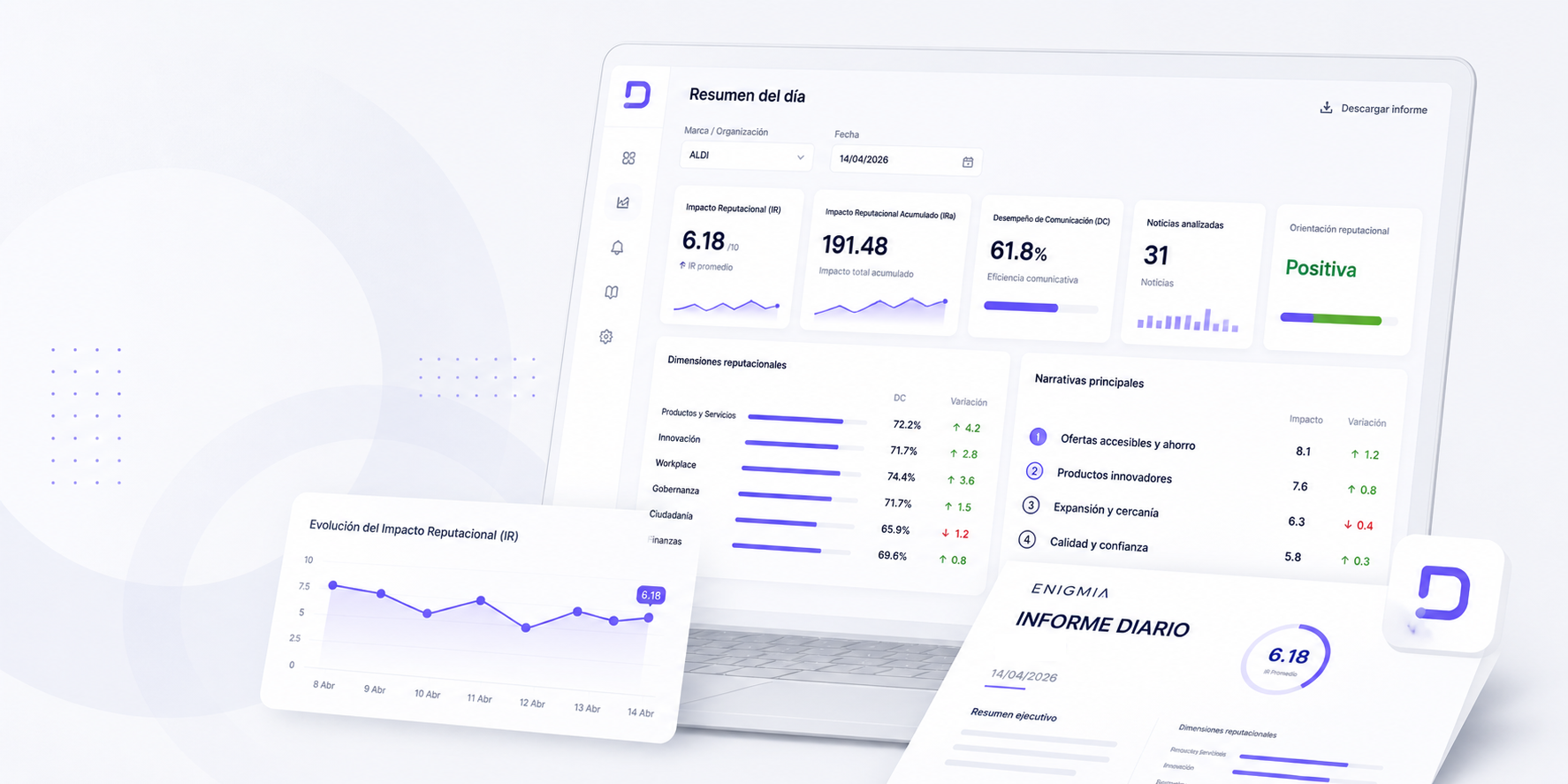
Enigmia allows you to move from basic coverage measurement to a structured reading of media, reputational and communicative impact.
Their approach is not limited to answering how many times a brand appears in the media. They analyze what impact that presence generates, what meaning it constructs, and what communicative value it can produce.
To achieve this, Enigmia works with different layers of analysis:
- Identify content, mentions, and sources
- analyzes the actor's role within each piece
- interprets the context and active narratives
- classifies reputational dimensions and attributes
- It calculates indicators such as Reputational Impact and Communication Value
- It allows you to compare actors, brands, campaigns, sponsors, or competitors
- and translates the results into reports, dashboards, rankings, or recommendations useful for decision-making
This approach is particularly useful for departments of communications, marketing, branding, sponsorship, public affairs, and strategic management. In all these areas, the issue is no longer just measuring visibility, but understanding what effect that visibility has on the organization's public standing.
Enigmia doesn't just measure how often a brand appears in the media. It measures the impact of that appearance, the narrative it activates, the attributes it reinforces, and the communicative value it can produce.
Measuring media impact is about measuring value, not just visibility
Measuring media impact is no longer simply a matter of volume. Knowing how many times a brand appears or what potential audience a campaign has reached is useful, but insufficient for making strategic decisions.
The real value lies in understanding what meaning that presence generates: what narratives it activates, what attributes it reinforces, what reputation it builds, and what capacity it has to generate communicative impact.
In campaigns, sponsorships, advertising, events or corporate communication strategies, this reading allows you to evaluate not only the exposure obtained, but the real value generated by that exposure.
When the measurement of media impact incorporates reputation, narrative and Communication Value, it ceases to be a reporting exercise and becomes an intelligence tool for better decision-making.












 Spanish
  English
  Portuguese
  French
  German
  Italian