






The reputation of an organization It is no longer built solely through what it communicates. It is also built from how its decisions, its spokespeople, its results, its crises, its silences, and its actions are interpreted in the public sphere.
Table of Contents
Media, social networks, Sectoral debates, institutional discourses, digital communities, and influential actors participate daily in the construction of narratives that affect a company's trust, legitimacy, and public position.
In this context, artificial intelligence has become a crucial tool for communications teams. But its true value lies not only in automating the monitoring of mentions or classifying conversations as positive or negative. Its value lies in helping to answer a much more fundamental question. relevant for a Communications Director: that reputational impact It is generating public conversation about my organization and what decisions I should make based on that analysis.
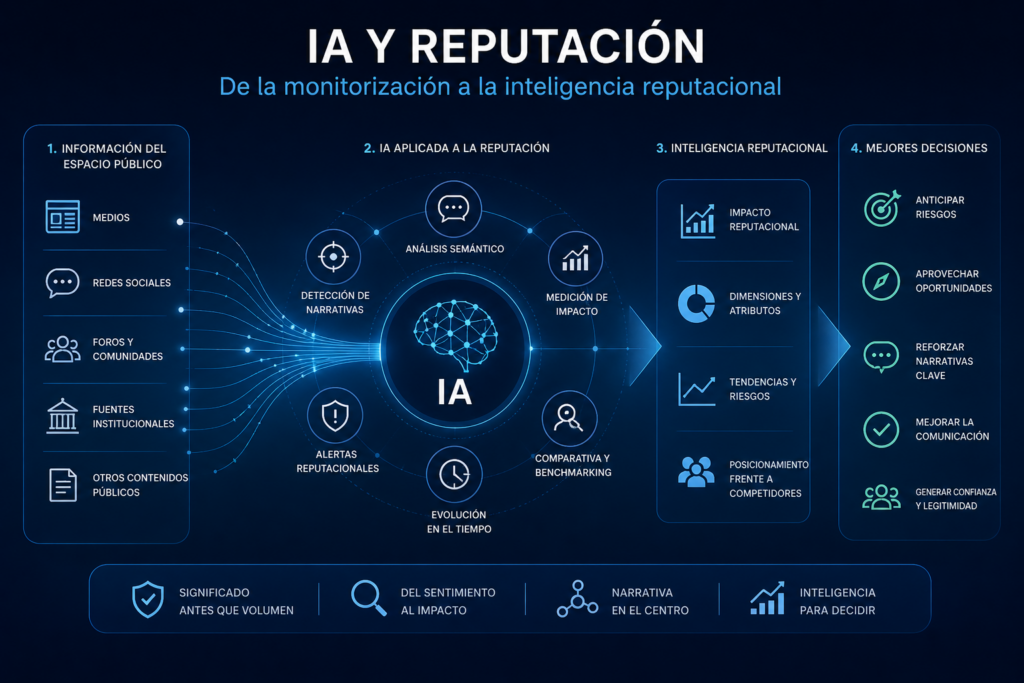
AI applied to reputation allows us to move from a descriptive logic—knowing how much is being said about a company—to a strategic logic: understanding which narratives are consolidating, which reputational dimensions are being reinforced or eroded, what risks are beginning to appear, and what positioning opportunities can be taken advantage of.
Why reputation can no longer be measured by volume alone
For years, many organizations have managed their digital reputation based on operational indicators: number of mentions, potential reach, interactions, sentiment, traffic or visibility.
This data is useful, but insufficient.
An increase in mentions does not necessarily imply an improvement in reputation. It could be a response to a crisis, a controversy, an effective campaign, a high-impact news story, or an irrelevant conversation. Similarly, a seemingly neutral conversation can trigger narratives that erode trust in a company in the medium term.
Reputation doesn't depend solely on the amount of conversation. It depends on how the organization appears, with what meaning, in what context, with what prominence and associated with what attributes.
This is where AI brings about a significant change. It allows for the analysis of large volumes of public information, but also the interpretation of semantic patterns, relationships between actors, narrative frameworks, and reputational signals that are not visible in a superficial reading of metrics.
AI and reputation: what really changes
Artificial intelligence applied to reputation introduces a new capability for communication teams: transforming scattered information into structured knowledge.
It's not just about knowing what's been published about an organization. It's about understanding. What story is being told about her?.
A single news story might cover financial results, sustainability, regulation, or leadership. But from a reputational standpoint, the subject matter isn't the only important factor. What matters is the narrative it creates: an innovative company, a business under regulatory pressure, a solvent organization, a leadership under scrutiny, a committed brand, or an institution detached from the real problems of its stakeholders.
AI makes it possible to identify these narratives and connect them with specific reputational dimensions: capability, integrity, leadership, innovation, social commitment, approachability, or governance. In this way, the analysis ceases to be a mere sum of impacts and becomes a structured interpretation of the organization's public position.
From sentiment analysis to reputational impact
One of the most widespread uses of AI in online reputation management has been sentiment analysis. This technique classifies mentions or conversations as positive, negative, or neutral.
The problem is that feeling does not equal reputation.
A news story can have a neutral tone and still reinforce an unfavorable narrative. It can also have a positive tone but contribute little reputational value if the organization appears in a secondary role or without relevant associated attributes. That's why communications teams need to look beyond sentiment.
AI-powered reputation analysis should incorporate at least four levels:
- The content, to find out what has been published or said.
- The mention, to identify which actor each fragment actually affects.
- The narrative, to interpret what story is being constructed.
- The reputational impact, to measure how that narrative affects the organization's public position.
This leap is key. It allows us to distinguish between visibility and impact, between noise and signal, between public presence and real reputation.
What can AI measure in corporate reputation?
An advanced reputation AI platform can help communications teams measure and interpret different aspects of public space.
First, it allows you to analyze the reputational impact of the information that affects an organization. It does not simply count appearances, but evaluates the reputational quality of each impact based on the context, the narrative, the prominence, and the associated attributes.
Secondly, it allows the study of the cumulative evolution of reputation. Reputation is not built on a single news story, nor is it damaged by a single conversation. It is formed through a succession of impacts, persistent narratives, and patterns that solidify over time.
Third, AI allows for the evaluation of communication performance. In other words, to what extent is an organization leveraging its public presence to generate a positive reputational impact? This analysis is especially useful for communications directors who need to demonstrate the strategic value of communication to management committees.
Fourth, it allows analysis of the relative position compared to competitors or sector benchmarks. Reputation is always best understood within a context. Knowing whether a company is improving or declining is important; knowing whether it's performing better or worse than its competitors is far more relevant.
Finally, AI allows for detection emerging narrative risks. Not every crisis begins with a large volume of conversation. Many start with an emerging narrative, a change in perspective, an accumulation of weak signals, or a negative association that begins to repeat itself.
AI as a reputational alert system
One of the main benefits of AI applied to reputation is its ability to anticipate risks.
But a reputational alert shouldn't be triggered simply because the volume of mentions is increasing. The volume can increase for many reasons. What's relevant is detecting when that increase is associated with a sensitive narrative, a critical reputational dimension, or a loss of control over the public frame.
An advanced reputational intelligence system can identify signals such as:
- emergence of negative narratives with the ability to sway public opinion;
- increased impacts associated with integrity, governance or trust;
- change of tone in relevant sources;
- greater prominence of the organization in critical content;
- persistence of a narrative for several days or weeks;
- activation of new actors in a controversy.
This type of alert allows communications teams to act before a situation escalates into a full-blown crisis. The key is not just responding quickly. It's understanding precisely what is happening, why it is happening, and what reputational impact is at stake.
AI to make better communication decisions
Reputation is not managed solely through diagnosis. It is managed through decision-making.
Therefore, AI applied to reputation management should help answer practical questions for communications management:
- which narratives should be reinforced;
- which reputational attributes are losing importance;
- which issues generate real reputational risk;
- which media or sources are having the greatest impact;
- which competitors are best capitalizing on certain conversations;
- which communication actions are generating value and which are not;
- which corporate decisions can affect the public legitimacy of the organization.
When AI is integrated with a solid reputation model, the analysis ceases to be a data panel and becomes a decision support system.
The role of the Communications Director in reputational intelligence
AI does not replace the Communications Director's judgment. It reinforces it.
Corporate communication requires interpreting context, anticipating social sensitivities, understanding internal balances, assessing political implications, and making decisions in uncertain situations. No automated system can replace that function.
What AI can do is provide a more solid analytical foundation: detecting patterns, organizing information, measuring impact, comparing actors, and making visible dynamics that would otherwise remain hidden.
The Communications Director thus goes from operating with a partial view of the public conversation to having a structured reading of the reputational environment in which his organization operates.
From online reputation to public space intelligence
Talking about “online reputation” has fallen short for many organizations. Reputation isn't built solely on search engines, social media, or reviews. It's built in a broader public sphere, where media, institutions, regulators, opinion leaders, employees, customers, investors, and digital communities interact.
Therefore, AI applied to reputation management must evolve towards a broader concept: reputational intelligence.
Reputational intelligence allows us to understand how public narratives affect an organization's position, how their impact evolves over time, and what decisions can strengthen its legitimacy, trustworthiness, and ability to act.
This is the difference between monitoring mentions and managing reputation with a strategic approach.
Conclusion: AI improves reputation when it helps to understand its impact
Artificial intelligence improves reputation management when it allows you to interpret the meaning of public conversation, not just measure its volume.
Its value lies in transforming scattered data into a structured reading: what is said, what narrative is activated, what reputational dimension is affected, what impact it generates, and what decision the organization should make.
For communications teams, this change is fundamental. Reputational AI allows them to anticipate risks, measure the real impact of communications, compare the organization's position against its competitors, and transform reputation into a useful variable for strategic management.
In an environment where trust, legitimacy, and public positioning increasingly influence the ability of organizations to act, the question is no longer whether AI can help manage reputation.
The question is whether organizations will continue to measure noise or begin to measure impact.












 Spanish
  English
  Portuguese
  French
  German
  Italian